








Romania at Davos: Inside the circle shaping the Global Longevity Agenda
In Davos, the directions that will define medicine for the coming years are being set. Romania was present precisely where longevity officially moved from discourse into medical architecture. Davos is where the agenda is written for industries, public policy, and the next years of investment and research.
In January, within the forums dedicated to health and longevity, one direction was placed explicitly on the working table: aging is being treated as a systemic medical target, integrated into the official architecture of healthcare, with direct implications for prevention, research, and governance.
Romania was present in this decision-making space — not as an observer, but as part of the group contributing to the direction-setting. One of the central figures in this movement is Ilia Stambler, PhD, President of the International Longevity Alliance, a federation bringing together 75 organizations from over 60 countries. For more than a decade, this ecosystem has worked not on popularizing longevity, but on institutionalizing it.
The result of this effort is now visible in ICD-11, where aging is officially integrated through the conceptual framework known as ASCA – Ageing as a Systemic Causal Agent. ASCA recognizes aging as a systemic causal agent underlying major chronic diseases — cardiovascular, metabolic, and neurodegenerative — and opens the path toward structured medical interventions based on prevention and biomarkers. This is the architecture of longevity medicine currently being built at a global level.
This is the context in which Romania entered the conversation. Marcel Martinas represented Romania at Davos not to receive directions, but to contribute to them. The discussions took place in a restricted setting and focused on the scientific governance of longevity: how these theoretical frameworks translate into studies, clinical infrastructure, and real-world implementation.
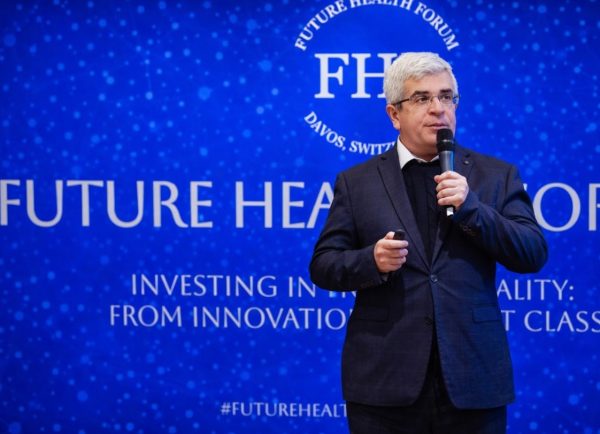
“Regenage Pharma was brought into the discussion not as a brand, but as a development platform for a precise direction: a patented product designed according to ASCA logic, already validated at the development level and prepared to enter clinical trials in human subjects. This positioning moves Romania from the realm of discourse into the realm of tangible contribution. There is clear consensus in the scientific literature and in policy discussions: longevity begins with the cardiovascular system.
The product that is about to enter study targets arterial stiffness, one of the most robust markers of vascular aging and an independent predictor of cardiovascular mortality. Arterial stiffness reflects the loss of elasticity in large vessels and is the mechanism through which biological aging translates directly into heart attack, stroke, and reduced life expectancy. Low-grade systemic inflammation accelerates this process by affecting endothelial function and vascular remodeling.
For this reason, cardiovascular health is now treated as the first pillar of longevity medicine, not a secondary component. The clinical study that is about to begin is randomized, placebo-controlled, and will be coordinated by Vladiana Romina Turi, MD, senior cardiologist, Medical Director of the Azeena Institute, with clinical and research expertise in preventive cardiology and the mechanisms of vascular aging. Her role is strictly medical: coordination of the clinical protocol, selection of relevant biomarkers, and integration of results into a clinical evaluation framework aligned with international standards.” — Marcel Martinas.
An element that strengthened Romania’s position in these discussions is the opening, on January 24, of an international-level Longevity Institute in Romania — the Azeena Institute. Not a service center and not a wellness concept, but a multidisciplinary medical institute built for prevention, biomarkers, research, and clinical follow-up — precisely the type of infrastructure required by the ASCA architecture.
“In this context, Ilia Stambler, PhD, included a visit to the institute in Romania on the working agenda, as part of the dialogue regarding the scientific governance of the study and its integration into an emerging international network of longevity science. This positioning does not remain limited to research and infrastructure.
During this year, Romania will also become a meeting ground for global dialogue on longevity, with the arrival in the country of international leaders directly involved in shaping the health forums in Davos. They will contribute to organizing a major event dedicated to longevity medicine, built on the same architecture of ideas, governance, and priorities that defined the Davos meetings.
This is not about replicating a format, but about extending a working framework: the same architects of global discussions, the same structural themes — cardiovascular prevention, biomarkers, clinical validation, infrastructure — moved into a context where Romania is no longer just a participant, but a host and co-author of the conversation.”
This is the moment when Romania is participating in defining the language, mechanisms, and priorities in a field that is now taking shape globally. Not through grand statements, but through: a patented product designed on ASCA logic; a cardiology-led clinical study; a longevity institute built to international standards; and presence within the governance circle where directions are set. In longevity, the agenda will not be written by those who speak the loudest, but by those who connect research, medicine, and infrastructure. As of today, Romania is in that circle.