




UK Packaging Pact launches to unlock progress in transforming packaging
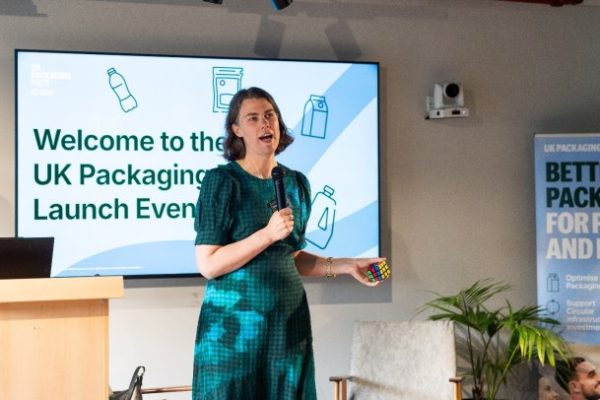
The UK Packaging Pact had its official launch yesterday at Sustainable Ventures. Attended by founding signatories, the event brought together businesses, governments, and experts to mark the start of a ten-year programme to unlock progress towards transforming the UK’s packaging system into a sustainable operation through coordinated action, across multiple sectors.
Catherine David, CEO WRAP
, “The UK Packaging Pact is a unique, complete system approach to unlocking packaging transitions across the value chain. No other programme brings together the key players needed to deliver the enormous changes we must make. Policies are essential, but they alone cannot deliver and the Packaging Pact will deliver the practical change necessary through a flexible framework allowing signatories to focus on the actions most important to them.
“Today, we begin to unlock progress – to reduce businesses costs – to mitigate against risks – and to prepare for the future. In the UK Packaging Pact, we offer an exclusive mechanism to create workable policies to deliver the circularity outcomes needed by businesses and government – and crucially, the planet.”
The launch of the UK Packaging Pact follows the World Bank’s third What a Waste (3.0) report and the stark warning that waste generation is outpacing population growth and the capacity of local systems to cope. A business-as-usual approach could mean global waste spirals to 3.86 billion tonnes by 2050 – a 50% increase. At the same time, global prices for oil and energy threaten businesses. The IEA Oil Market Report shows that price volatility is no longer simply cyclical, but also structural and driven by geopolitical instability. Virgin plastic resin prices are directly tied to oil market shocks, and high and volatile input costs are disproportionately affecting single use packaging models.
WRAP, the global environmental action NGO which has created the UK Packaging Pact, has developed the new cross-sector agreement to help industry manage costs and address the part packaging plays in this growing perfect storm. The new agreement takes up from where its predecessor (the UK Plastics Pact) led and expands to every packaging material placed on the market from glass, paper, card, metal, as well as plastics and biobased materials.
At a time of major regulatory change with the Packaging and Packaging Waste Regulations, Extended Producer Responsibility, Deposit Return Scheme and Simpler Recycling, the UK Packaging Pact will help businesses and regulators by ensuring reforms are effective, helping to future proof businesses by driving down business costs, and helping advise governments on the evolution of policy – ensuring business readiness.
The UK Packaging Pact will transform how we design, use, reuse and recover many more packaging types to cut waste and emissions, protect nature, and put citizens’ needs at the heart of packaging decisions. It is the only forum addressing the entire system from root to branch and uniting key actors – supported by WRAP’s independent evidence base and technical expertise – through a shared vision and coordinated action across the value chain. Through pre-competitive collaboration, signatories will be able to:
- Reduce costs and EPR fees through smarter design and material reduction,
- Cut greenhouse gas emissions,
- Prepare for and comply with evolving UK and EU regulation, and
- Identify and unlock opportunities for reuse and recycling infrastructure investment.
The UK Packaging Pact has four interconnected goals:
- Optimise Packaging – for the reduction of single-use packaging, removal of problematic packaging and more recyclable packaging. To encourage right-weighting, reduce virgin fossil-fuel derived materials and increase recycled content.
- Scaling Reuse and Refill – to drive interoperable systems to increase the proportion of packaging that is reusable compared to single-use.
- Support infrastructure investment – to build reliable evidence base with which to accelerate and unlock new investment for key materials. To identify system bottlenecks and support initiatives to address these; across policy reforms, citizen engagement, innovation, collections and processing.
- Harmonise data – to simplify data reporting requirements through standardisation and alignment, improving traceability and enabling data-led design and sourcing decisions.
The Pact also provides a direct route for industry to help inform and shape how regulation is implemented in practice. In its first year, as well as establishing the governance structure for The Pact, key workstreams will include:
- Identifying key opportunities for material reduction, increasing recycled content and addressing material loses and scoping and initiating projects to address them,
- Providing supporting evidence on the evolution of the RAM for pEPR,
- Addressing the challenge of non-recyclable multi-material films,
- Policy advice on mechanisms to incentivise reuse and investment in critical recycling infrastructure,
- Solutions to scale reuse and refill, and
- Development of a vision for data harmonisation and reducing the burden on business of reporting.
Helen Fenwick, Senior Corporate Affairs Manager, Unilever UK & Ireland, “Unilever UK is proud to be a founding signatory of the UK Packaging Pact. The Pact will provide an invaluable forum for businesses, government and the wider value chain to collaborate on practical solutions to reduce packaging waste and increase circularity, while supporting delivery of our plastics goals. We look forward to working with WRAP and Pact partners to build on the progress made to date.”