






You know how many people enter your stores, but SIT-Mobil shows you how many walk past
In June, SIT promised audience estimates for the areas surrounding points of sale. Today, VALMARE AI Technologies is extending SIT-Mobil to the retail sector: the same technology used to measure mobile OOH (Out-of-Home) campaigns now counts potential customers in the vicinity of your stores.
#TheDenominator
You know how many customers entered your store yesterday. You know how much they spent and at what time. You have a door counter, a cash register, and a report waiting for you every morning.
And yet, one figure is missing: how many people walked past your store yesterday without coming in?
Without it, all your other figures lack a denominator. Two hundred entries represent a success on a street with five hundred passersby, but a red flag on a street with five thousand. You cannot see this difference from inside the store.
You pay rent for foot traffic. You design your storefront to attract passersby. You invest in campaigns to capture attention. Until now, you’ve been investing in all three based on little more than trust.
#Profile
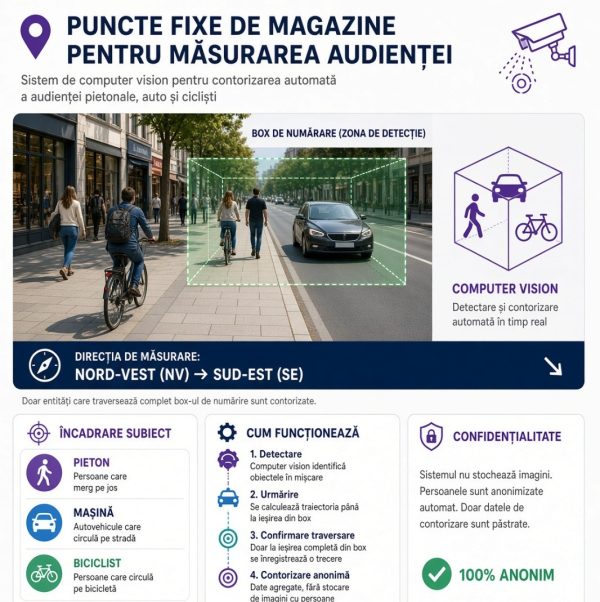
Vehicles equipped with SIT-Mobil are already circulating throughout the city. As they travel, the system counts what it observes around your stores—pedestrians, cyclists, and vehicles.
Using these observations, a proprietary statistical method developed by VALMARE AI Technologies determines the profile of the area surrounding your store: when it is busy, when it is quiet, who passes through on foot, and who simply drives by.
There is no need to install anything, disrupt operations, or change anything within your store. You receive the rhythm of your street, ready for you to analyze. This method is the subject of a patent application filed with OSIM.
#capture
Compare the street profile against your store’s actual foot traffic, and you’ll uncover a metric you’ve likely never had before: the *capture rate*. Out of everyone passing by, how many actually walk through your door?
Once you see this, your decision-making becomes much clearer:
• Operating hours. Identify times when the street is bustling, yet your store is closed or understaffed.
• Storefront/Window display. High foot traffic combined with low entry numbers points to an issue at the entrance, not on the street itself.
• Campaigns. Launch your messaging when your audience is actually present, then track whether the capture rate shifts.
• Network management. Evaluate all your locations using the same benchmark to distinguish between stores that are truly high-performing and those that simply benefit from a prime street location.
• Rent negotiations. Negotiate based on real foot traffic data, rather than mere promises.
Imagine your Monday morning meeting: alongside your sales figures, you now have data on the street itself. How many discussions—previously based on intuition—could be resolved in just five minutes?
#rigor
No field measurement can capture the full picture of a street all day long, and SIT-Mobil makes no such claim. Each report explicitly distinguishes between what was directly OBSERVED and what has been statistically MODELED.
The capture rate is derived from the modeled street profile. It is, therefore, an estimate—presented as such—rather than a raw, mechanical count.
Why does this matter? Because a figure you can verify is worth far more than one that simply sounds good. You can present the report to the CFO, the property owner, or the agency, and everyone can see the origin of each figure.
“We don’t just hand the retailer a round number. We tell them exactly what we counted and what we’ve derived statistically from those counts. And we clearly state in the report which figure is which.” – Valentin Adrian Țenescu, Engineer and Co-founder of VALMARE AI Technologies.
The three principles announced in June also apply to the retail sector: a public methodology, an identical rate card for all clients, and an external methodological council.
#gdprbydesign
SIT-Mobil counts; it does not perform facial recognition. It does not identify faces, store images, or transmit video feeds. Processing takes place entirely on the device; the only data sent from the unit are the counts—broken down by category—and the location where they were recorded.
For the retailer, this means peace of mind. Their customers are neither tracked, recognized, nor profiled. The street becomes a readable rhythm, while the people on it remain anonymous.
#nextsteps
“Retailers pay rent for foot traffic and advertising for attention. Until now, they’ve been purchasing both without a scale. We’re putting the scale in their hands.” – Marian Costache, Engineer and Co-founder of VALMARE AI Technologies.
VALMARE is now opening its program to the first retail partners. Our units are already out in the field—your street might even be on our route. If you’d like to see it in terms of data, reach out to us at contact@valmare.ro.
And what if you want to see even more? For retailers requiring an additional level of detail, VALMARE prepares bespoke configurations upon request. More on this, coming soon.
About VALMARE AI Technologies
VALMARE AI Technologies is a Romanian AI engineering startup, founded in 2026 by engineers Valentin Adrian Țenescu and Marian Costache. The company develops SIT, an audience measurement platform that runs artificial intelligence directly on the device (edge AI) and is GDPR-compliant by design. VALMARE aims to bring objective, auditable, and reproducible metrics to the out-of-home advertising and retail sectors, based on three core principles: a public methodology, identical rate cards for all clients, and an external methodological council.