




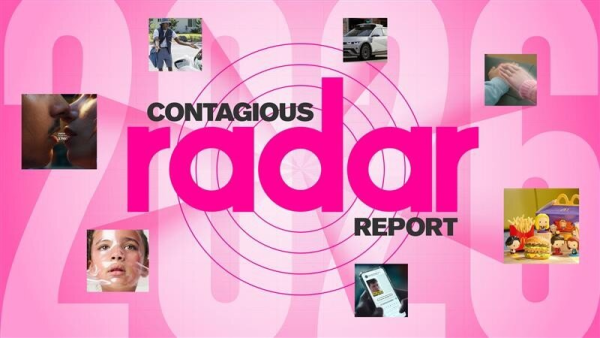
Contagious Radar 2026 reveals the key trends set to shape culture and marketing in the year ahead
The Contagious Radar 2026 identifies key cultural and technological trends that will impact the marketing industry in the year ahead. From the rise of nostalgia to the death of aspiration, the report highlights how brands can adapt to meet evolving consumer needs.
The report is also an annual industry health check, giving a read on how the best minds in marketing feel about the state of the sector in 2026. It polls 100 C-suite marketing and agency leaders, revealing the pressing challenges that will test their resilience in the year ahead.
Katrina Stirton Dodd, Trends Editor, Contagious, said:
“Welcome to the Cold War of AI. 2026 marks the delicate balance of automation – a race driven by efficiency but shadowed by existential unease. That unease seeps through the six trends explored in this year’s Radar, spanning our enduring appetite for meaning, comfort, connection and protection. Running through them all is a clear, human through-line: the longing for a little more control, a little more agency in the face of relentless uncertainty.”
The six key trends outlined in the Contagious Radar 2026 are:
1.The Attention Sink
In a world of infinite content, attention, memory, and meaning are collapsing. Platforms like Netflix, YouTube and TikTok are overwhelming audiences with choice, while AI accelerates the deluge. Cognitive overload means short-form content dominates as consumers turn to efficient entertainment, but shallow engagement poses a challenge for brands’ need to create an enduring impression.
For many, the answer is to produce less, focusing on higher-quality content to stand out amidst the noise. As MrBeast, the world’s most-subscribed YouTuber, aptly notes, “There’s a big difference between someone consuming a five-second clip of you versus watching a 20-minute video and… getting to know you.”
2.The Nostalgia Industrial Complex
Nostalgia is no longer a fleeting indulgence; it’s a state of mind and a powerful emotional anchor in a chaotic world. From increasing vinyl records sales and GenZ’s nostalgia for the 1990s to Y2K-inspired campaigns, brands are tapping into the emotional resonance of bygone eras to connect with today’s audiences.
The strategic question for brands is whether they’re building from the archive or merely displaying it – the past is not a creative idea.
3.The Loneliness Disconnect
Big Tech once promised connection at scale. It didn’t go as planned. Now, AI-powered relationships are in danger of becoming a substitute for real ones – in the US, 28% of adults report at least one intimate or romantic relationship with AI.
Brands have an opportunity to counteract this trend, supporting togetherness by fostering in-person encounters and real-world belonging. Initiatives like Heineken’s Rooftop Revival in Seoul and Mattel’s Uno Social Club are creating spaces and reasons for people to gather and connect.
4.Social as a Vice
The debate around social media has shifted from connection to protection. With bans on social media for under-16s gaining traction globally, platforms are under scrutiny for causing addiction, as argued by Ursula von de Leyen, President of the European Commission. They’re also facing questions about their impact on wellbeing – according to Pew Research 44% of US parents say social media is the top threat to teens’ mental health.
Brands must navigate this landscape carefully, prioritising ethical media spending and exploring safer online environments, such as podcasts, as well as mitigating risk by using creators and traditional – regulated – media.
5.The Optimisation Obligation
Beauty culture has transformed from aspirational to non-negotiable. The relentless pursuit of perfection, fueled by trends like TikTok’s #glowup, the recently launched kid’s line rini, and AI-driven beauty scoring, has made self-improvement feel mandatory.
Rather than add to the pressure, brands should consider how to support consumers through education and authenticity: there’s an opportunity to go beyond helping people look like they’re flourishing to helping them actually feel it.
6.The Death of Aspiration
Traditional milestones like homeownership and career advancement are increasingly unattainable – especially for younger generations. Instead, consumers are focusing on the present, embracing micro-indulgences and professional minimalism. Ipsos data shows 66% of people globally agree with the statement ‘I live for today because the future is uncertain.’
Brands like Ikea and Asics are recalibrating their messaging to make the present feel meaningful. When you can’t rely on tomorrow, it makes sense to invest in today.
Survey Insights: Industry Resilience Amidst Change
As part of the Radar report, Contagious surveyed 100 C-suite marketing and agency leaders to gauge their perspectives on the pressing issues of the day. Key findings include:
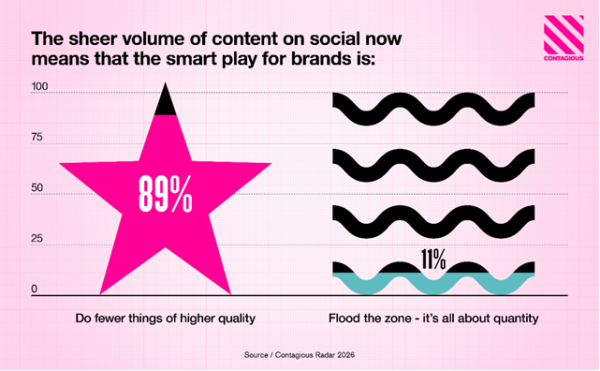
Social Media Strategy: Nearly nine out of ten (89%) respondents endorse quality over quantity as the key approach, reflecting the need to ensure creative impact amidst the content overload.
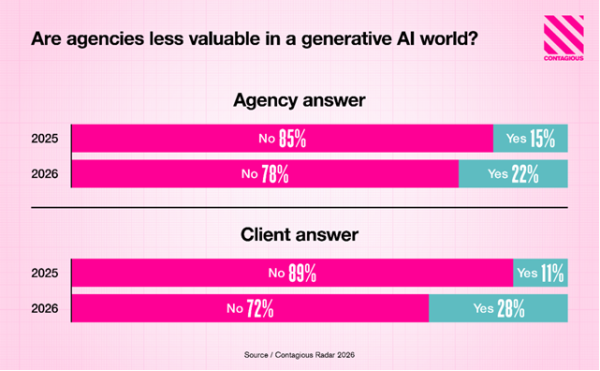
Generative AI’s Impact: While most respondents regularly use AI, just over a quarter (28%) of clients now believe the technology is devaluing agencies, more than double last year’s percentage (11% in 2025).
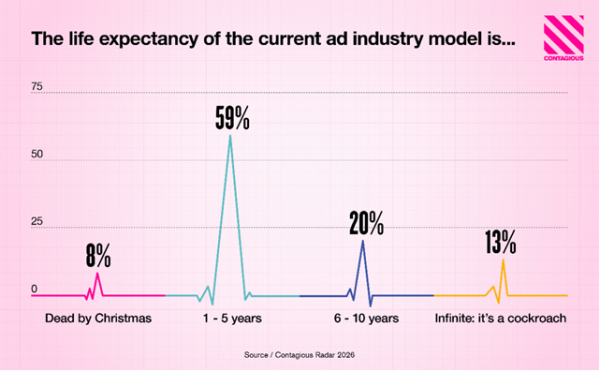
Optimism Levels: A majority (67%) of marketing and agency C-suite leaders believe the current ad industry model has a maximum life expectancy of just five years.
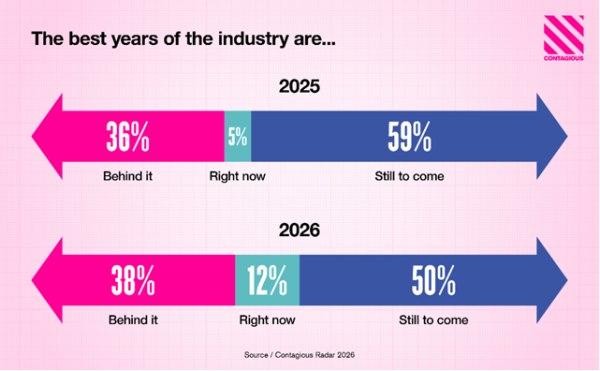
Carpe Diem Mindset: However, the proportion of respondents who believe the best years of the industry are ‘right now’ has more than doubled year-on-year, signaling less blithe confidence that a brighter future is coming.
Summing up, Contagious’s Katrina Stirton Dodd, added:
“The Contagious Radar 2026 report underscores the importance of adaptability and creativity in navigating a rapidly changing cultural and marketing landscape. As aspiration evolves and attention fragments, brands must recalibrate their strategies to resonate with consumers seeking meaning, comfort, and connection in uncertain times.”